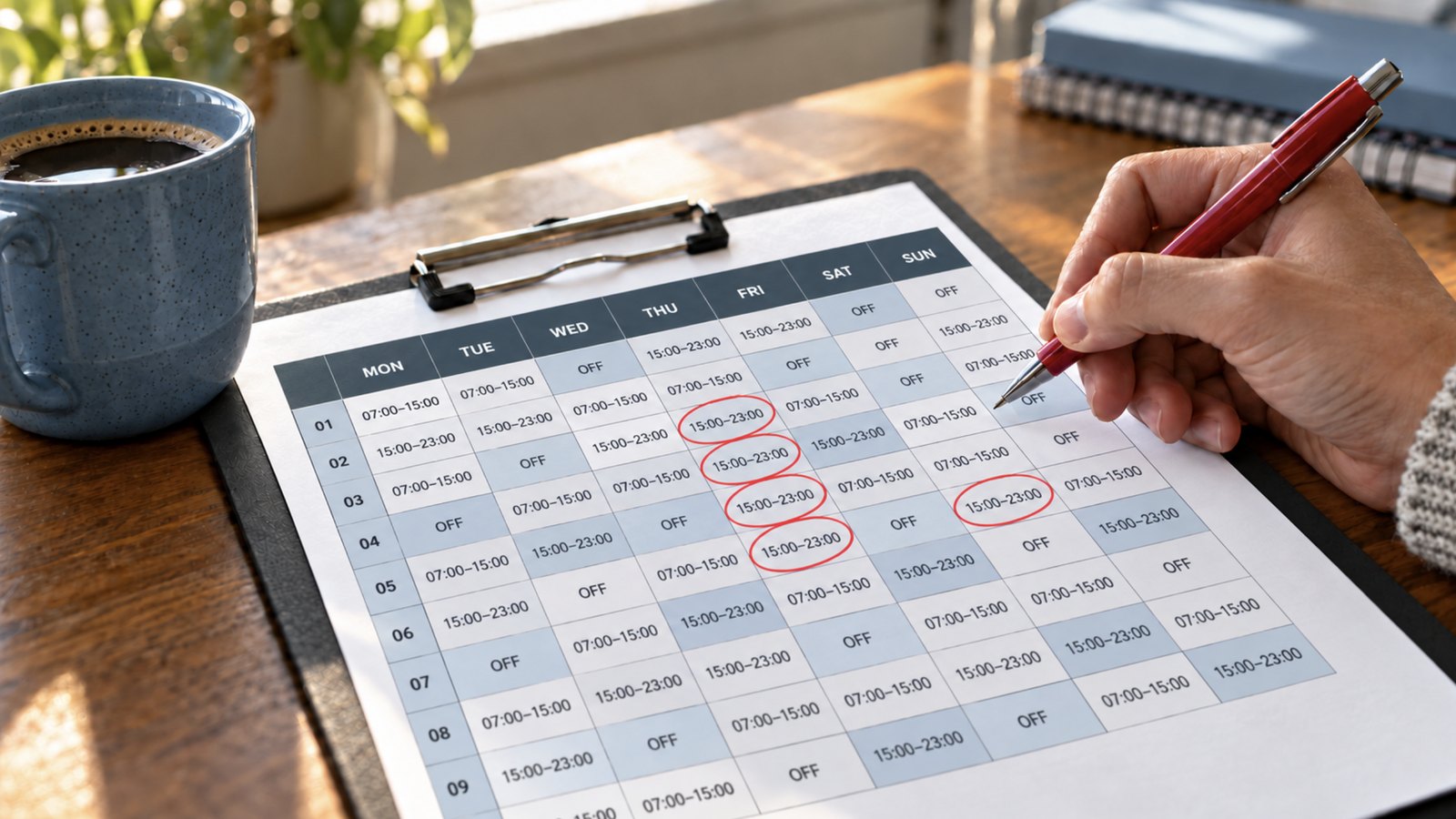

An employee call-off policy tells hourly staff exactly how, when and to whom they report an absence, and tells supervisors what happens next. A good policy uses one official channel, sets a reporting deadline before shift start, lists the information every call-off must include, and spells out how the open shift gets covered. Below is a template you can copy, adapt and hand to your HR team, followed by how to put it into practice on every shift.
Download the free template (Word)
Why manufacturing needs a written call-off policy
On a production line, one missing operator can slow a whole cell. When call-offs arrive in fragments (a voicemail on the call-in line, a text to a supervisor's personal phone, a message passed along by a coworker), three things go wrong:
- The supervisor finds out late, often after the shift has started.
- The record is incomplete, so attendance disputes become one person's word against another's.
- Coverage starts late, because nobody knows the shift is open until someone notices the gap.
A written policy fixes the rules. The template below is written so every rule can also be enforced automatically.
Employee call-off policy template
Copy this into your handbook and replace everything in [brackets]. Have HR and, where you have one, your union review it before you roll it out.
Download the editable Word version
1. Purpose and scope
This policy explains how employees of [Company] report an absence, late arrival or early departure, and how supervisors respond. It applies to all hourly employees at [site(s)] on every shift.
2. How to call off
Report every absence through the official call-off line: text or call [number]. This is the only accepted way to call off. Messages to a supervisor's personal phone, social media messages or word passed through a coworker do not count as a call-off.
If an emergency or hospital stay means you can’t call off yourself, call off as soon as you are able, or have someone call off for you.
3. When to call off
Call off at least [2] hours before your scheduled shift start. The call-off line is available 24 hours a day, 7 days a week. If you know about an absence in advance, request the time off through [time-off process] instead.
Running late or need to leave early? Use the same call-off line before your shift starts (or before you leave) and give your expected arrival or departure time.
[Check local law: some state and city paid sick-leave laws only require notice as soon as practicable for unexpected absences. Adjust this deadline if they apply to you.]
4. What to include
Every call-off must include:
- your name and employee ID
- the date and shift you will miss
- the reason, chosen from: [sick, personal, family emergency, medical appointment, other]
- your expected return date
You don’t need to share medical details. The reason code is enough.
5. Confirmation
Keep the confirmation of your call-off. It is your record that you reported the absence and when.
6. Absences longer than one shift
Report each shift you will miss unless [your supervisor has approved a multi-day absence / you have provided documentation]. [Documentation such as a doctor's note may be required after [3] consecutive days.]
[Check local law before requiring documentation. Some sick-leave laws limit when you can ask for a doctor’s note.]
7. Protected leave
If your absence is covered by FMLA, a state sick-leave law or another protected leave, report it through the same call-off line and say so in the reason. HR will handle the leave under [leave policy]. Protected absences are not counted as attendance occurrences where the law protects them.
8. Late call-offs and no-call no-shows
A call-off made less than [2] hours before shift start is a late call-off. Missing a shift without calling off is a no-call no-show. Both are handled under [attendance policy / progressive discipline]. [Two] consecutive no-call no-shows may be treated as [voluntary resignation], subject to [collective agreement / applicable law].
[Optional, if you use an attendance points system: a late call-off counts as [X] point(s) and a no-call no-show as [Y] points.]
9. Supervisor responsibilities
The supervisor on duty acknowledges each call-off within [15] minutes. If they don't, the call-off goes to [backup supervisor / HR]. The supervisor then decides whether the shift needs to be covered.
10. Covering the open shift
Open shifts are offered to qualified employees under [seniority rules / the collective agreement / our overtime and rest rules]. Employees accept an offer by replying to it. [If no employee accepts within [X] minutes, the shift may go to [staffing agency].]
11. Records and privacy
Call-off records are kept by [HR] for [period] and shared only with the people who need them to manage attendance and coverage.
12. Acknowledgement
I have read and understand the call-off policy.
Employee name: ________ Signature: ________ Date: ________
How to roll the policy out
- Pick one channel and publish the number. Put it on badges, break-room posters and the first page of the handbook. A policy with two "official" channels quickly turns into five.
- Brief supervisors first. They have to stop accepting call-offs on their personal phones, or the policy won't hold.
- Set your reason codes once. Use the same list in the policy, in payroll and in your reports, so the data lines up.
- Decide your escalation chain. Who covers for the supervisor at 3 a.m. on a Sunday?
- Write down your coverage rules. Who is eligible for an open shift, in what order and with what limits (seniority, certifications, overtime, rest).
- Review after 30 days. Check late call-offs, unacknowledged reports and how long open shifts stayed open.
How Frekyl automates this policy
Frekyl is an employee call-off system with optional automated shift-filling callouts. Each part of the template maps to something Frekyl does without a supervisor chasing it:
- How to call off (2): employees text or call one dedicated number. No app or login for employees; a flip phone or landline works.
- When to call off (3): the line takes call-offs 24/7, and every step is timestamped, so late call-offs are clear from the record.
- What to include (4): guided prompts collect the date of absence, return date and reason against your own reason codes, so every record is complete.
- Confirmation (5): texting leaves a written record on both sides.
- Supervisor responsibilities (9): the right managers are notified by SMS, email or in the Frekyl web app, according to your routing rules. An unacknowledged report can escalate automatically.
- Covering the open shift (10): add Shift Filling and a reported absence can open a callout automatically. Frekyl offers the shift to your own staff by text and automated call and awards it using the eligibility rules you set up. Agency Connect can send shifts that stay open to your staffing agencies.
- Attendance follow-up: employees see their year-to-date absence count during the call-off, and managers see patterns by employee, team, shift and reason.
Absence Reporting works on its own and can go live in one day. Shift Filling can be added when you're ready. See how Frekyl handles the call-off or how the open shift gets covered.
Frequently asked questions
What should an employee call-off policy include?
One official way to call off, a deadline before shift start, the information every call-off must include, how protected leave is reported, what counts as a late call-off or no-call no-show, who acknowledges the call-off, and how the open shift is covered.
How far in advance should employees call off?
Choose a deadline that gives the supervisor time to cover the shift, for example one to two hours before shift start, and apply it to everyone on every shift.
Should employees be allowed to text a supervisor to call off?
Not to a supervisor's personal phone. Personal texts are easy to miss, leave no shared record and stop working when the supervisor is off shift. Use one official number that logs every call-off.
How do you handle FMLA absences in a call-off policy?
Ask employees to report protected absences through the same channel and to say so in the reason, then let HR apply the leave policy. Check the wording with HR or legal counsel, and with your union if you have one.
What is the difference between a call-off and a no-call no-show?
A call-off is an absence the employee reports through the official channel. A no-call no-show is a missed shift with no report at all. Most policies treat no-call no-shows more seriously.
This template is general guidance, not legal advice. Review your policy with HR or legal counsel, and with your union where a collective agreement applies.
Explore Frekyl for manufacturing and logistics. Related reading: measuring absenteeism and intermittent FMLA call-offs.